
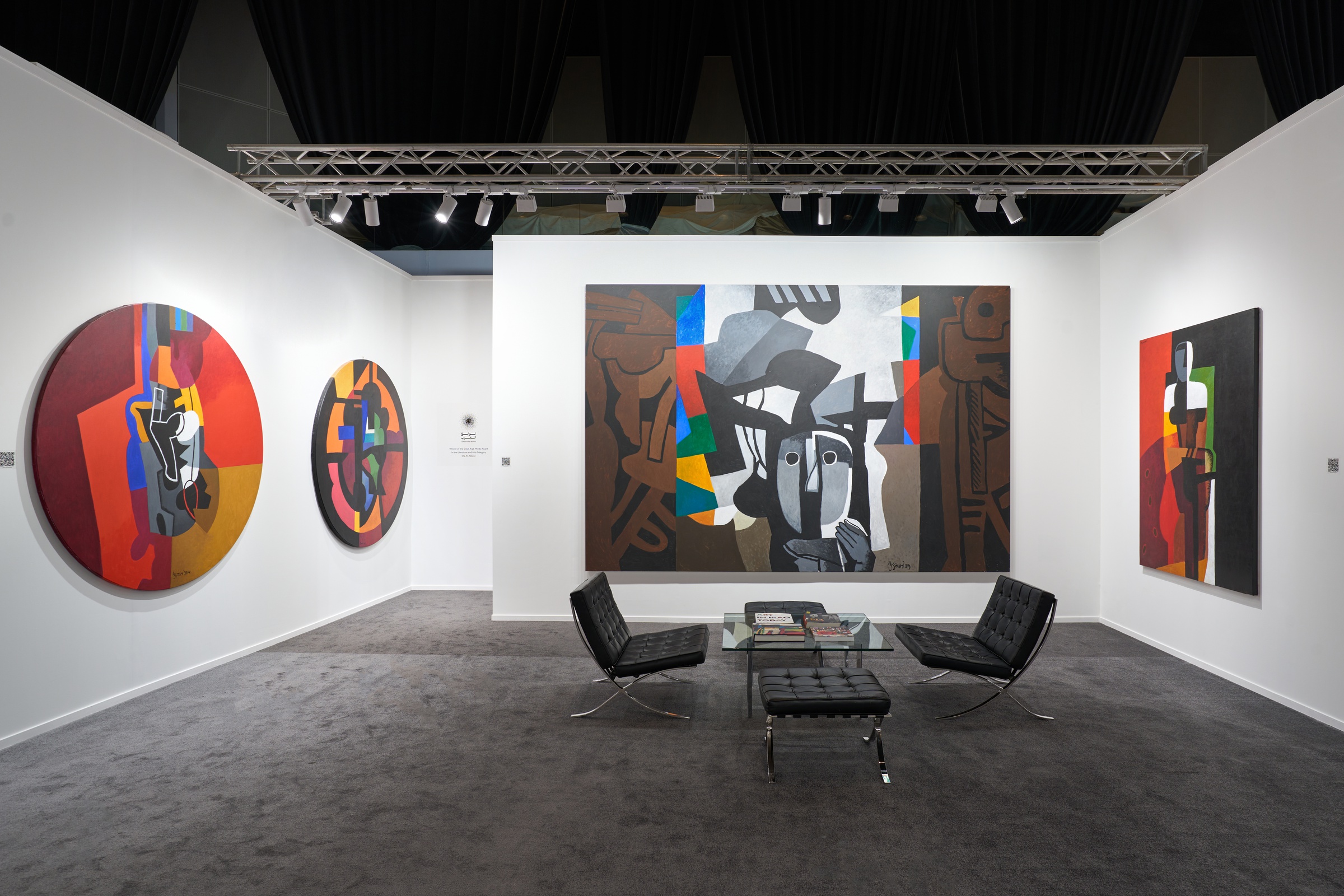
With the monumental work ‘Elegy to My Trapped City’ (2011) taking centre stage at the Louvre Abu Dhabi’s PICASSO exhibition in 2026 and Azzawi being awarded by HH Sheikh Mohammed bin Rashid Al Maktoum, the Great Arab Minds Award for 2024, Meem Gallery has brought exclusively the work of Dia al Azzawi to Art Dubai 2026.
The works presented include paintings from 1966 to 2025, Gouaches from 1972 to 1980 and Azzawi’s prints from 1978 to 2020.
Centre stage at Meem Gallery’s Booth at Art Dubai 2026 is the monumental work “Imaginary Portrait”(2019), painted in Azzawi’s studio in Lebanon, set back from the water in a shady grove just next to Nabu Museum in Batroun. Painted in 2019 using acrylic on canvas, this work had the benefit of being composed in a bright studio that encouraged Azzawi to paint on a larger scale, something which his traditional London studio can often restrict.
Azzawi as an artist has never been restricted in his exploration of time, space or creative imagination. While he may often use a distinct range of colours and some typical cultural motifs and artistic techniques, the worlds he creates within his canvases truly know no bounds. Imaginary Portrait allows us a view into an individual’s psyche—a daydream, or perhaps a necessary mental escape. The figure depicted is again painted with Azzawi’s unique, abstracted take on Sumerian figural forms, heavily inspired by sculptures of deities with simple facial features and distinct lineaments, but most importantly with the strong, rounded gaze which he incorporates in so many of his paintings. Delicately holding a hand up to his face, it seems as though this individual is thinking, pondering and imagining the possibility of a world beyond his own, living in his dreams and detached from the reality around him. In this visionary personal portrait, confined within linear demarcations created by the figure’s own mind, he has created a bright, animated and glowing alternative reality, surrounding himself with a burst of theatrical colour. However, beyond the frames of his fantasy, the real world exists, painted by Azzawi in varying dark tones of brown shapes set against a black backdrop, contrasting starkly with the vibrant atmosphere in the centre. Azzawi’s paintings can often reflect the realities of lived experience, political moments, and historical homages, and even within these contextual compositions he successfully creates a conceptual world devoid of limitations: Imaginary Portrait takes this one step further. Removed from any particularly unique or precise context, the person depicted represents many people living in a collective, unrestricted dreamlike state or condition—a concept Azzawi has explored often in the past in his painterly examinations of the human condition, or ‘halat insaniyya’. Furthermore, this also extends to his unique personal approach to abstraction within his work as, for Azzawi, abstraction is not just merely an artistic style, but also a tool to shift and unsettle temporal, spatial and mortal perceptions.
Text has been supplied by Mysa Kafil-Hussain of The Azzawi Studio.
